
Thinking Like Leonardo
Your child carries these seven principles well beyond our classroom.
From Preschool through Grade 8, LDVA teachers use the same framework to shape how children think, not just what they learn. It's adapted from Michael J. Gelb's How to Think Like Leonardo da Vinci, which identifies seven principles behind Leonardo's own thinking. We use them as guiding principles for teachers, students, and parents alike.
The Seven Da Vincian Principles
Each principle pairs what it means with how it actually shows up at LDVA.
Image Source: Arciszewski, 2009.
I
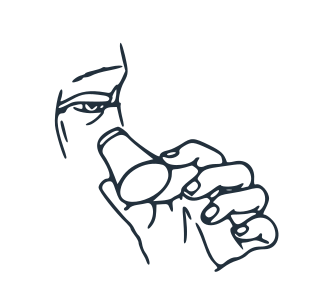
Curiosità
(Curiosity)
A curious approach to life and a genuine drive to keep learning. At LDVA, students ask thoughtful questions, follow their own interests, and take an active role in their learning, nurtured daily through hands-on experiences, inquiry, and open-ended exploration.
II
Dimostrazione
(Perseverance)
A commitment to test knowledge through real experience, persistence, and a willingness to learn from mistakes. At LDVA, students build confidence through hands-on learning, problem-solving, and reflection, treating mistakes as part of learning and trying again.


III
Sensazione
(Refining the Senses)
Sharpening all the senses to enliven experience and strengthen our connection to the natural world. At LDVA, students observe thoughtfully and engage all their senses in the learning process, building their ability to notice detail, ask thoughtful questions, and learn through discovery.
IV
Sfumato
(Embracing Uncertainty)
A willingness to embrace ambiguity, paradox, and uncertainty, staying curious and open-minded instead of fearing the unknown. At LDVA, students face real challenges without an obvious answer, learning to think creatively, consider different perspectives, and approach uncertainty with confidence.

V
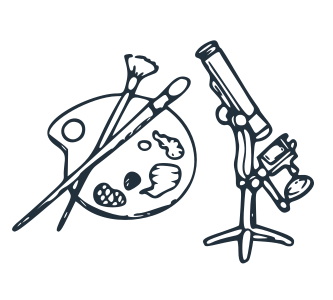
Arte/Scienza
(Arts & Science)
A balance between art, logic, and imagination. Leonardo believed creativity and analytical reasoning work together to drive innovation. At LDVA, students are encouraged to balance imagination with analytical reasoning, engaging both the creative and logical sides of the mind to build whole-brain thinking and strengthen critical thinking and problem-solving.
VI
Corporalità
(Corporality)
Cultivating grace, fitness, coordination, poise, and body awareness. At LDVA, we nurture the whole child by recognizing the connection between physical well-being and the development of the mind, building coordination, confidence, resilience, and body awareness through active play and daily movement.


VII
Connessione
(Connections)
Recognizing and appreciating how all things and ideas are interconnected. At LDVA, students make connections across subjects and see how their learning extends beyond the classroom, becoming thoughtful, responsible learners who understand how people, cultures, and ideas connect.
See Thinking Like Leonardo in the classroom.
A 30-minute visit with our Admissions team. See the classrooms while they are in session and ask us anything.